Almost half of UK retirees stopped work earlier than they had planned. For most, the date wasn’t their choice. A retirement plan that assumes you’ll pick the date is a plan only half-built.
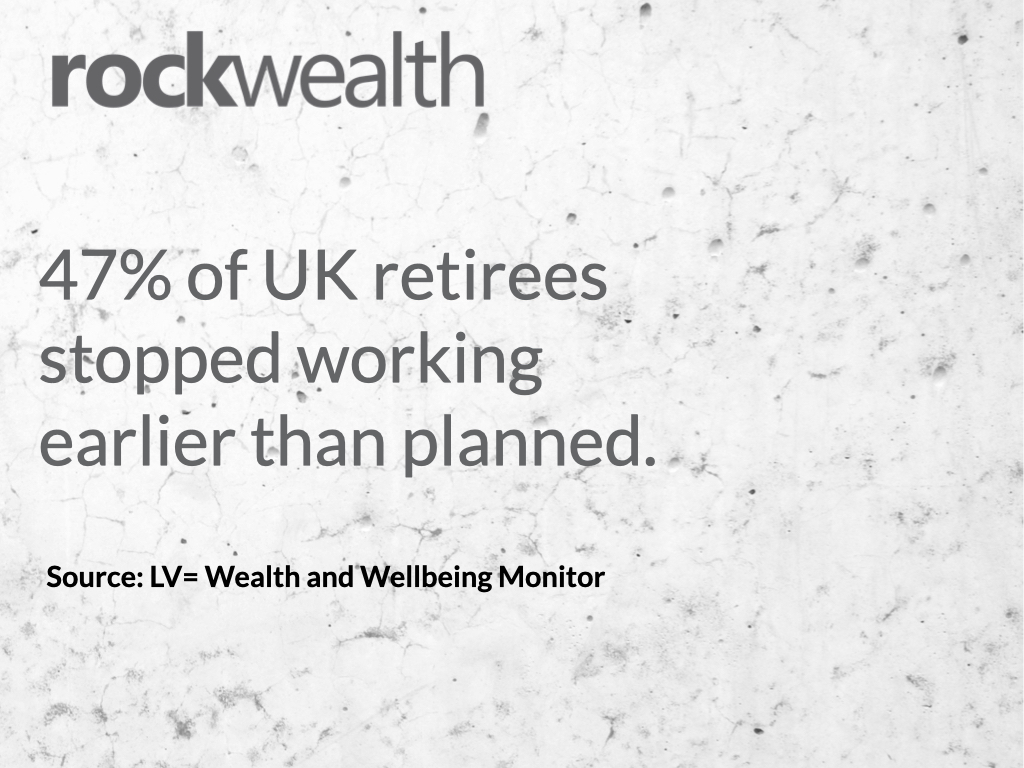
Around 47 per cent of UK retirees stopped working earlier than they had planned, and one in four did so at least five years sooner than they intended. That comes from the most recent wave of LV=’s Wealth and Wellbeing Monitor, a quarterly survey of 4,000 UK adults. Translated into people, that’s roughly six million retired Britons.
Unexpected early retirement is not a marginal risk for UK savers. It’s a statistical expectation.
That matters because most retirement planning assumes the planner controls the date. The architecture of cash flow modelling, contribution forecasts and drawdown rates rests on a chosen finishing line. The data says the finishing line moves, and it usually moves in one direction.
You’ve probably seen this happen to someone close to you. A colleague pushed out in a restructure at 58. A friend whose spouse was diagnosed with a condition that ended both careers in the same week. A parent who left work to care for theirs. The question this article tries to answer is whether your own plan would survive the same shock. Not the emotional shock, the financial one.
The promise here isn’t advice on what to do if the date arrives early. It’s a plan that doesn’t depend on the date in the first place.
When the plan and the reality diverge
The standard retirement plan rests on three assumptions that the evidence keeps breaking.
The first is that you’ll work to the age you’ve chosen. The second is that your earnings will hold up in the years immediately before retirement. The third is that any drawdown happens on your timetable, not someone else’s.
Take the first. The EBRI 2026 Retirement Confidence Survey, published in April, found that 46 per cent of US workers who retired in 2025 left earlier than they had anticipated, and 76 per cent of those early exits were driven by factors outside the individual’s control. The LV= figure isn’t a UK quirk. The pattern shows up wherever researchers measure it.
The second assumption is no safer. Research from the Institute for Fiscal Studies during the pandemic period (Crawford & Karjalainen, 2020) showed that involuntary unemployment in the years before retirement forces older workers to draw on pension savings earlier than they had intended. Worse, those drawdowns often happen in the same downturn that triggered the job loss, locking in losses the market would otherwise have given time to recover.
The third assumption fails in a different way. Smith (2006), using the British Household Panel Survey, found that when retirement is voluntary, food spending and individual well-being are broadly smoothed through the transition. When retirement is involuntary, both fall sharply. The retirement-consumption puzzle, in other words, is only a puzzle for people who didn’t choose the date.
Caregiving adds another layer. Carers UK estimates that around 600 working-age adults leave the UK labour force every day to provide unpaid care. For those carers, being out of work is the single strongest predictor of poverty.
The cost of all this is arithmetic. Retire involuntarily at 60 instead of 65 and the plan that assumed 30 years of decumulation has to cover 35. Contributions that were supposed to compound for another five years stop. The gap is rarely small.
Why the date stays fixed in our heads
The conventional plan fixes the date because the planners do. And the planners do because the psychology of retirement timing rests on a single number the data keeps disproving.
Confidence is rising, not falling. Fidelity’s 2026 State of Retirement Planning, an online survey of 2,015 US adults conducted in December 2025, found that 72 per cent of respondents now expect to retire on their own terms. That’s up five percentage points year on year. The proportion of people who actually do retire on their own terms hasn’t budged.
This is the planning fallacy in plain terms. You anchor on a single age, treat the conditions around it as fixed and underweight everything you can’t control. The age in your head is rarely the age you arrive at.
A new UK study makes the gap unusually clear. Kanabar and Kalwij (2025), drawing on the UK Household Longitudinal Study and the 2007, 2011 and 2014 Pension Acts, found that when the State Pension age rises, actual retirement is genuinely deferred. Younger workers, however, fail to revise their expected retirement age upward in response. Some women, particularly those with occupational pensions, adjust theirs in the opposite direction, expecting to leave earlier than the new rules would suggest. Subjective expectations don’t track the objective evidence.
Ricky Kanabar put it bluntly in the University of Bath release that accompanied the paper in July 2025: ‘Overoptimism regarding retirement income and reliance on access to workplace pensions from their mid-50s could lead to prime-aged workers having to make unplanned changes to later-life employment to adequately fund retirement.’
You can’t fix this by being smarter. The bias has been documented for decades. Plans built around the expected age inherit the bias by default. The fix isn’t better forecasting; it’s a different way of designing the plan.
Building an unexpected early retirement plan around a range, not a number
A retirement plan that survives unexpected early retirement is built on three things the conventional plan tends to ignore: a range of retirement ages rather than a single date, protection against income loss and access to advice that can adjust the plan when reality moves.
Start with the range. Run two cash flow models, not one. The first answers the obvious question: what does my plan look like if I retire at the age I want? The second answers the more useful one: what does it look like if work ends five years sooner? The gap between the two outcomes is the size of the resilience you need to build into everything else.
Now protection. Income protection is the most under-utilised piece of personal financial architecture in the UK. The FCA’s Pure Protection Market Study Consumer Research Summary, published alongside the FCA’s December 2025 interim report and based on responses from more than 14,000 adults, found that 58 per cent of UK adults hold no protection products of any kind. Only 14 per cent hold income protection.
When involuntary early retirement is triggered by ill health, income protection stops the pension being drawn down years before the plan assumed. Reframed in those terms, protection isn’t a separate insurance silo. It’s the part of the retirement plan that absorbs the shocks the rest of the plan can’t.
Advisers seem to be catching on. Swiss Re’s Term & Health Watch 2026 reports that income protection sales grew 11.9 per cent in 2025, the only protection product line to grow against a market down 1.7 per cent overall.
The third is advice. Gomez-Cardona (2026), writing in the Review of Economics of the Household, shows that financial literacy reduces the welfare cost of an unexpected household shock by at least 20 per cent. The paper models fertility shocks, but the author argues the same dynamic applies to health shocks and other involuntary disruptions. The effect is largest for mid-wealth households, where literacy or access to an adviser acts as an almost complete shield against post-shock welfare loss. Households who can think clearly about money behave, after a shock, much like households who saw it coming.
Most UK adults don’t have that buffer. The FCA’s Financial Lives 2024 Survey, published in May 2025, found that only around nine per cent of UK adults had received regulated financial advice in the previous 12 months. Industry research, including the Lang Cat’s annual Advice Gap Report with Royal London, documents the gap widening as minimum asset thresholds rise. Mass-affluent households fall outside the advised cohort even as their planning becomes more complex.
Three steps that change the maths
Three practical moves close most of the gap between the plan you have and the plan that can absorb the date you didn’t choose.
The first is to model two retirement ages, not one. The age you want and the age five years earlier. Compare the outcomes. If the earlier date breaks the plan, the plan isn’t a plan; it’s a forecast. A forecast is what you adjust when life cooperates. A plan is what holds when life doesn’t.
The second is to check the protection. If income protection cover is absent, ask why. For working-age savers whose pension trajectory still depends on continued contributions, the absence of income protection is usually the single biggest unhedged risk in the household balance sheet. It isn’t always the right cover for every situation, but its absence should be a deliberate choice rather than a default.
The third is to get a second pair of eyes on the whole picture. Whether that’s formal advice or a structured review with someone who knows the household well, the Gomez-Cardona finding generalises. An outside view cuts the welfare cost of a shock substantially: by at least a fifth on her estimates, and considerably more for mid-wealth households. The shock doesn’t go away. The damage does.
The same principles apply in US planning practice. Kamila Elliott, a certified financial planner and CEO of Collective Wealth Partners, has argued repeatedly that the late-career playbook comes down to three things: clear high-interest debt before retirement, maximise catch-up contributions and secure long-term care or income-replacement insurance before the option is taken away by a diagnosis.
None of this removes the possibility of unexpected early retirement. The data is clear that nothing does. What these steps change is what happens after it. The arithmetic stops being existential and starts being manageable.
The plan that doesn’t depend on the date
A good retirement plan is judged by what happens to it when the date moves.
The 47 per cent figure is uncomfortable not because the data is new but because the way most plans are built quietly assumes it doesn’t apply to the reader. It does. The honest version of the question every UK saver in their 50s should be asking isn’t ‘will I retire when I plan to?’ but ‘what does my plan look like if I don’t?’
The answer isn’t to plan for the worst case as the only case. It’s to make sure the plan still works if either case arrives. That means a range instead of a number, protection where the gap would otherwise open and a second view from someone whose job is to test the assumptions before reality does.
If you’d like to find out how your own plan would hold up against unexpected early retirement, Mark Roe at rockwealth Wharfedale can help.
Resources
Gomez-Cardona, S. (2026). Financial literacy, shocks, and portfolio adjustments. Review of Economics of the Household. Online First.
Kanabar, R., & Kalwij, A. (2025). State pension eligibility age and retirement behaviour: evidence from the United Kingdom household longitudinal study. Journal of Pension Economics and Finance.
Smith, S. (2006). The retirement-consumption puzzle and involuntary early retirement: Evidence from the British Household Panel Survey. Economic Journal, 116(510), C130–C148.
Financial Adviser and Financial Planner in Wharfedale
rockwealth Wharfedale is a fixed-fee Independent Financial Adviser situated in Wharfedale, North Yorkshire.About Us: Nestled in Wharfedale, rockwealth is your dedicated local financial planning firm. From tailored financial advice to pension and retirement advice, evidence-based investing, and inheritance tax planning, we are here to facilitate your financial journey in Wharfedale and the broader North Yorkshire area.
Interested to work with us?: Begin your financial journey with us through an Initial Discovery Consultation, completely free of charge and without any obligation. You can visit us at our office, schedule a video call, or call us on: 0113 541 9373.