
Global equities have climbed steadily since late 2022. That feels reassuring. But a century of market data suggests most investors are drawing exactly the wrong conclusions from it.
You know the feeling. Markets are up. Your portfolio looks healthy. The panic of 2022, when inflation surged, interest rates spiked, and geopolitical shocks rattled everything, feels like a distant memory.
Even when trouble flared, it didn’t last. In April 2025, fears of an escalating trade war triggered a sharp sell-off that pushed major indices into correction territory. Headlines turned apocalyptic. And then, within weeks, markets recovered their losses as trade tensions eased and earnings came in strong. By mid-May the upward trend was back.
Bull markets create a peculiar cocktail of competing emotions. Some investors grow complacent, assuming the good times will continue indefinitely. Others grow anxious, convinced a deeper crash is overdue. A third group simply feels the itch to do something, to tinker, to act, to respond to the nagging sense that it can’t be this easy.
All three instincts lead to the same place: poor decisions at precisely the wrong time.
Research from Cass Business School suggests UK investors lose approximately 1.2% a year through mistimed moves, buying after rallies and selling after falls. On a £500,000 portfolio over 20 years, that quiet erosion costs roughly £200,000. Not from choosing the wrong funds. Not from bad luck. From reacting to exactly the kind of emotions that a rising market stirs up.
But there’s good news. Morningstar’s Q1 2026 Markets Observer offers three lessons that cut through the noise. They won’t make you rich quickly. They’re far too boring for that. But they might stop you making the expensive mistakes that bull markets are so good at provoking.
This bull market is normal. That’s the point.
The current rally feels exceptional. It isn’t. And understanding why matters more than most investors realise.
Jeffrey Ptak, Morningstar’s head of research, recently analysed a century of US stock market history in the chart below. It maps every expansion, downturn, and recovery since 1926. What it shows is worth remembering every time markets wobble.
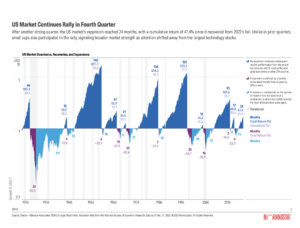
Since 1926, there have been 11 expansions. The average lasted 69 months and delivered a cumulative return of 224%, or 20.8% annualised. The longest ran for more than 12 years, from November 1949 to December 1961. The shortest survived just 12 months before the next decline hit.
The current expansion? As of December 2025, it was 25 months old with an annualised return of 21.4%. In other words, shorter than average and producing returns almost exactly in line with the historical norm. Not even halfway through a typical run.
Even measured from the September 2022 low, the picture is the same. Markets have risen roughly 93% at 22.5% annualised. That’s only marginally above the 20.6% average for comparable periods. Nothing about this bull market is unusual.
But here’s the statistic that really deserves attention.
Roughly 40% of the past century has been spent either falling from, or climbing back to, previous highs. Strip out the Depression era and it’s still 31%. The market has logged 142 months in bear territory and another 349 months clawing its way back to where it started. Add those together and you find that markets have spent nearly as much time in pain as in celebration.
Ptak puts it well. The argument that stocks are just one nasty downturn away from permanent failure, he writes, “doesn’t hold water based on market history.” Downturns are real. They hurt. But they are also the ordinary cost of earning long-term returns. The chart makes this viscerally clear: every single decline, including the ones that took years to recover from, was eventually followed by a new expansion.
The danger isn’t the next bear market. It’s what investors do when it arrives.
Vanguard’s research into what it calls Adviser’s Alpha estimates that behavioural coaching, simply helping investors resist the urge to sell at the worst moment, adds approximately 1.5% in net annual returns. That’s not a product benefit. It’s the measurable value of having someone talk you out of doing something stupid when your portfolio drops 30% and every instinct screams get out.
Markets have seasons. The warm spells feel permanent. So do the cold snaps. Neither is. A century of data confirms this with remarkable consistency. The smart response isn’t trying to predict the next turn in the weather. It’s dressing in layers and staying outside.
What this bull market is hiding
Today’s returns are flattering yesterday’s winners and quietly punishing investors who chase them.
The chart below, from Morningstar’s Q1 2026 Markets Observer, should unsettle anyone heavily tilted towards US equities. It breaks future expected returns into their component parts: yield, growth, inflation, currency effects, and a crucial fifth ingredient called the valuation adjustment. This methodology draws on the supply-side framework developed by Straehl and Ibbotson, which decomposes long-run stock returns into the cash flows that actually drive them, rather than relying on past price movements to predict future ones.
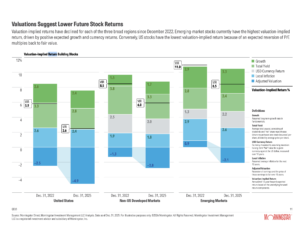
The numbers are striking. US equities carry a valuation adjustment of -4.9%. That single figure drags Morningstar’s estimated ten-year annualised return for US stocks down to just 2.6%. Emerging markets, starting from far cheaper valuations, show an estimated return of 11.0%. Non-US developed markets sit at 6.0%.
In other words, the market that has delivered the most spectacular recent gains is now priced to deliver the lowest future returns. And the regions most investors have been ignoring, or actively abandoning, offer the strongest forward-looking prospects. This isn’t a fringe opinion from a bearish newsletter. It’s Morningstar’s institutional research, built on a peer-reviewed framework with data stretching back to 1871.
The pattern played out in real time during 2025. Five of the seven Magnificent Seven stocks underperformed the S&P 500. Through October, the Morningstar Global Markets ex-US Index beat the US Market Index by 10.6% in dollar terms. The market was already rotating, but most investors’ portfolios weren’t.
The weather analogy holds. After a prolonged heatwave, people forget what cold feels like. They stop carrying a jacket. Investors who’ve spent years watching US large-cap growth dominate have quietly abandoned diversification for concentration, owning more of the market that’s priced to disappoint and less of the markets priced to deliver.
Concentration isn’t conviction. It’s a bet that the recent past will repeat, made at precisely the moment when forward-looking evidence suggests it won’t.
The bull market lesson most investors have already learned
UK investors don’t need a lecture on active management. They’ve been walking away from it for years.
Investment Association data tells a blunt story. In 2025, tracker funds attracted £12.8 billion of new money. Active funds lost £15.1 billion. Over the four years from 2022 to 2025, the cumulative withdrawal from active strategies reached £120.9 billion. Laith Khalaf, head of investment analysis at AJ Bell, calls it “the Great Active Fund Exodus”. That’s not hyperbole. It’s arithmetic.
And the performance data explains why.
AJ Bell’s latest Manager versus Machine report, found that just 24% of active funds beat a comparable passive alternative over the previous decade. That’s the lowest figure since the report launched in 2021, when 56% of active managers cleared the bar. The collapse has been driven by three sectors that matter most to ordinary investors: UK, US, and global equities. In each, large-cap dominance has given tracker funds a structural edge that most stock-pickers simply can’t overcome.
UK equity funds have endured a full decade of continuous outflows. £71 billion, gone. Even a strong year for the FTSE 100 in 2025, with the index closing at record highs, couldn’t reverse the trend. £11.1 billion still walked out the door. When strong performance can’t attract fresh capital, something fundamental has shifted. Investors aren’t reacting to a bad year. They’re responding to a broken model.
This matters for the bull market conversation because it changes who benefits from the next leg up, and how. Investors in low-cost global trackers capture broad market returns by default. They don’t need to predict which region, sector, or manager will outperform next quarter. They own the weather, good and bad, across every climate zone.
The shift isn’t complete. Index trackers still represent only 25% of UK funds under management. But the direction is unmistakable, and the evidence supporting it grows stronger with every annual report card.
Dressing for every bull market season
The best response to a bull market isn’t excitement, caution, or cleverness. It’s preparation.
A century of data confirms that expansions are the norm, not the exception. Forward-looking valuations remind us that yesterday’s winners rarely lead the next decade. And £120.9 billion of fund flows suggest that millions of UK investors have already grasped what the industry spent decades obscuring: costs matter, diversification works, and complexity is rarely your friend.
None of this requires predicting what markets will do next month or next year. It requires a plan built on evidence rather than emotion, broad enough to capture returns wherever they emerge, and cheap enough to let compounding do its work without friction eating the gains.
Bull markets reward the patient and the prepared. Not the clever. Not the lucky. The ones who dressed in layers before the weather turned.
If you’d like help building a portfolio grounded in evidence-based investing rather than prediction, rockwealth Wharfedale offers a free initial consultation. Get in touch to find out how we can help.
Financial Adviser and Financial Planner in Wharfedale
rockwealth Wharfedale is a fixed-fee Independent Financial Adviser situated in Wharfedale, North Yorkshire.About Us: Nestled in Wharfedale, rockwealth is your dedicated local financial planning firm. From tailored financial advice to pension and retirement advice, evidence-based investing, and inheritance tax planning, we are here to facilitate your financial journey in Wharfedale and the broader North Yorkshire area.
Interested to work with us?: Begin your financial journey with us through an Initial Discovery Consultation, completely free of charge and without any obligation. You can visit us at our office, schedule a video call, or call us on: 0113 541 9373.