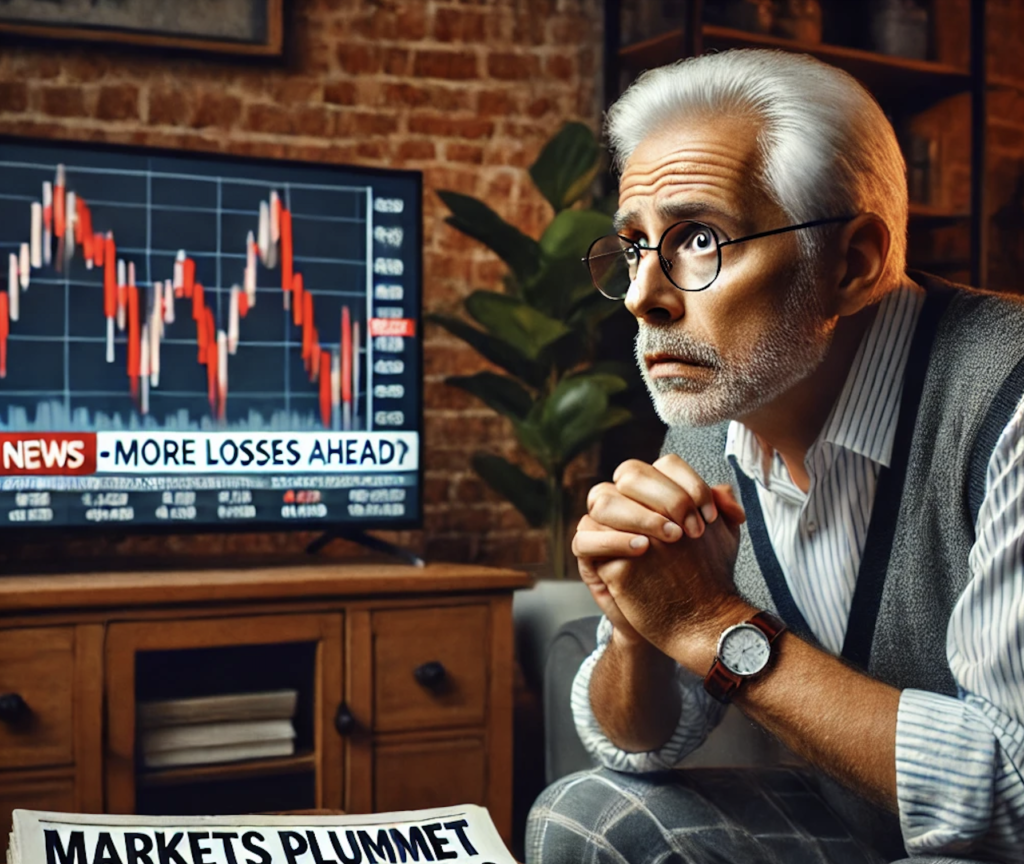
Something that holds many investors back is a fear of losses. When markets fall, they panic and sell. Worse still, they’re so anxious about losing money that they don’t invest in risky assets like equities at all. It’s a big problem, but, with a combination of self-discipline and professional help, you can prevent loss aversion impeding your investment goals.
Have you ever been in an unfulfilling relationship and yet chosen to stay because the fear of loneliness, rejection or regret seemed to outweigh the potential benefits of moving on? Have you put up with a job you didn’t particularly like because finding a better one required you to leave your comfort zone? Or have you put off starting a new diet or exercise regime because it was easier to stay as you were?
If the answer to any of these questions is yes, then you’ve exhibited a classic behavioural bias called loss aversion. Essentially it means that we experience the pain of losing something more intensely than the pleasure of an equivalent gain. Loss aversion can lead people to make overly cautious decisions, avoiding risks even when the potential rewards outweigh the losses.
It’s perfectly natural for human beings to behave this way. Our brains are wired to respond to threats and negative outcomes. From an evolutionary perspective, avoiding losses or dangers, like physical harm or lack of food, was crucial for survival. But, in a modern-day setting, this ingrained response can often be counter-productive.
“Losses loom larger than gains”
Investing is a perfect example. Two academics who shaped our understanding of how loss aversion affects investors were Daniel Kahneman and Amos Tversky. For Kahneman and Tversky, loss aversion was a key part of what they called prospect theory, a broader framework they developed to explain how people make decisions under uncertainty.
Prospect theory challenges traditional economic models that assume people are rational beings who always seek to “maximise utility” — or, in an investing context, achieve the highest returns they possibly can. Instead, Kahneman and Tversky demonstrated, “losses loom larger than gains.” In other words, investors experience the pain of losing money more intensely than the pleasure of gaining the same amount, which causes them to make irrational decisions.
Of course, it seems perfectly reasonable for investors to dislike incurring losses. What’s the problem with that? Well, investing is, or at least should be, a very long-term commitment. The best way to build wealth over the long run is to invest in stocks, or equities. Over short time horizons, though, stock markets can be very volatile. They can suddenly fall ten or 20 percent or more.
The high price of emotional comfort
Because of loss aversion, investors can feel deeply uncomfortable in a market crash or correction. Often they’re tempted to reduce their risk exposure to relieve themselves of that discomfort. Some investors move their money out of equities altogether.
The evidence shows us that selling some or all of your stocks after markets have already fallen is usually a bad strategy. Because the best days for stock markets often come straight after the worst days, it’s easy to miss out on substantial gains. Even if you think you’ve timed the market “correctly”, because markets continued to fall, you still have to time your re-entry. Many investors who reduce their market exposure don’t start buying again until long after the recovery has begun.
To put it another way, timing the ups and downs of the stock market on anything like a consistent basis is extremely challenging. To enjoy the long-term benefits of investing in stocks, you need to be able to withstand short term-losses.
The biggest risk of all
There is, however, an even bigger risk than acting on impulse, reducing your risk exposure after the markets have fallen, and locking in losses, and that’s not taking enough risk in the first place.
Human beings are very sensitive to what we consider to be immediate threats. Again, it’s part of our evolutionary make-up. For our ancestors, being eaten by a predator or attacked by rival tribes was a real danger. But, in today’s world, some of the biggest threats we face are long-term threats, like climate change for instance.
The greatest financial danger people face in the 2020s is not that their portfolio will suddenly fall in value by 20 percent, but that they will run out of money in later life, or at least won’t have enough money to enjoy the lifestyle they have been used to. According to the Office for National Statistics, average life expectancy in the UK is now about 82. The number of people living beyond 100 is also much higher than it was 20 years ago and continues to rise. So if, for example, you work from the age of 22 to the age of 60, and live to be 98, you’ll be spending as long in retirement as you’ll spend at work.
In other words, if you don’t take enough risk while you’re still earning an income, the danger is that you won’t have enough money to support you towards the end of your life. You may also have to forgo some of those luxuries you were looking forward to in retirement — regular foreign holidays and meals out, for instance, or being able to live in a plush retirement complex.
Three ways to deal with loss aversion
So, what can you do to stop your fear of losses impeding your investment goals? The single most important thing is to seek professional financial advice. Ideally, look for an adviser who has specialist expertise in investor psychology, who can help you to identify your behavioural biases and ensure that your decision-making process remains rational.
A good adviser is like an insurance against acting on your emotions and making silly mistakes. But they can also ensure that you’re taking sufficient risk, and the right kinds of risk, to maximise your chances of achieving your investment goals.
The second thing you can do is simply to recognise the nature of investing. It’s human nature to focus on what might go wrong. Markets fluctuate all the time, and will inevitably cause emotional discomfort. But over the very long term, patient investors have almost invariably been rewarded. Keep reminding yourself that, as long as you’re invested in a sensible, diversified portfolio, and you stay disciplined, you should have a successful outcome.
One final tip comes from two more influential behavioural psychologists, Shlomo Benartzi and Richard Thaler. In a 1995 paper called Myopic Loss Aversion and the Equity Premium Puzzle, Benartzi and Thaler explained that a common reason why investors are excessively cautious is that they check their portfolios too often. This frequent monitoring increases the likelihood of observing losses, which discourages them from investing in stocks at all. Investors, on the other hand, who only check their investments every once in a while, are more likely to invest in stocks and, crucially, stay invested.
Remember, loss aversion is a powerful, and perfectly natural, behavioural bias. But, in investing, it can be very unhelpful. The good news is that, with a combination of self-discipline and professional help, you can stop it getting the better of you.
GET IN TOUCH
Why not book a free consultation with rockwealth Wharfedale founder Mark Roe and set out on your evidence-based investment journey today?
Financial Adviser and Financial Planner in Wharfedale
rockwealth Wharfedale is a fixed-fee Independent Financial Adviser situated in Wharfedale, North Yorkshire.About Us: Nestled in Wharfedale, rockwealth is your dedicated local financial planning firm. From tailored financial advice to pension and retirement advice, evidence-based investing, and inheritance tax planning, we are here to facilitate your financial journey in Wharfedale and the broader North Yorkshire area.
Interested to work with us?: Begin your financial journey with us through an Initial Discovery Consultation, completely free of charge and without any obligation. You can visit us at our office, schedule a video call, or call us on: 0113 541 9373.